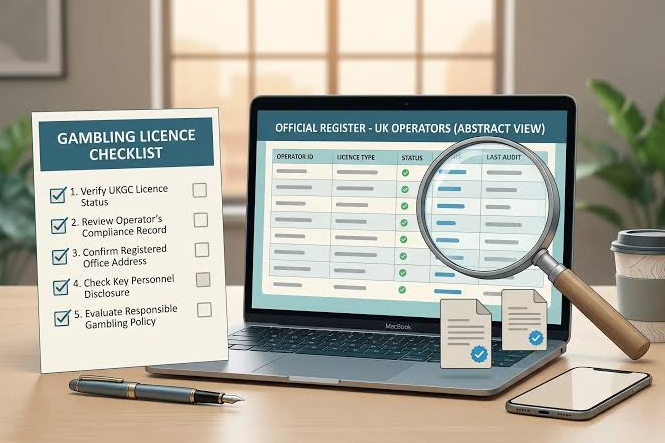

A casino brand name does not necessarily identify the company responsible for providing the gambling service. A licence check therefore begins with the legal entity named in the account terms and its connection to the website being used. For an offer presented as Iris Casino, that connection must be verified rather than inferred from the name, domain or appearance of the site. The next questions concern the status of the relevant authorization, the activities it covers and its territorial limits. A matching company record is an important starting point, but it does not by itself establish that every product or market is covered.
Matching the legal company name
The first task is to find the full legal name of the entity providing the gambling service. The account terms are particularly relevant because they should identify the contractual relationship. A footer, privacy notice or payment page may name additional companies with different responsibilities.
The legal name should be compared with the relevant official gambling register, where one is available. Supporting details such as the registered address, company identifier and jurisdiction can help distinguish similarly named entities. A close resemblance is not enough when the record concerns a different company.
Minor differences require interpretation rather than an automatic conclusion. A shortened legal suffix, translation or former company name may have an explanation, but that explanation needs evidence. A shared word or similar address does not establish that two entities are legally identical.
Corporate registration is not gambling authorization
A corporate register can confirm information about a company’s legal existence or status. It does not necessarily show that the company is authorized to operate a casino. Conversely, a gambling register may publish only selected corporate details, requiring a separate source for other information.
A payment statement can provide a useful clue, but its merchant description may identify a processor, collection company or another intermediary. It should not replace the contractual and regulatory evidence when identifying the gambling operator.
The result of this stage should be a specific, supportable identification of the operating entity. If that remains unclear, further checks should preserve the uncertainty instead of assigning responsibility to whichever group company is easiest to find.
Ownership versus responsibility for operating the casino
Owning a brand, holding a domain and operating a gambling service are different roles. They may belong to the same company, but they can also be distributed across several entities. A parent company’s ownership does not automatically extend a subsidiary’s authorization to the rest of the group.
The same distinction applies to technology suppliers. A company may provide software, hosting or platform services without being the entity that accepts customers’ bets. Its own authorization, if required, may cover business-to-business activities rather than operation of a consumer-facing casino.
| Role | What it may establish | What it does not establish alone |
| Brand owner | Ownership or control of a trading identity | Authorization to provide the gambling service |
| Domain registrant | A recorded relationship with an internet address | Responsibility for customer accounts or bets |
| Platform supplier | Provision of technical infrastructure or software | Consumer-facing operating authority |
| Gambling operator | The role identified in the applicable operating arrangements | Coverage of every product, domain or territory without further checks |
| Payment service company | A role in collecting or transferring funds | Responsibility for the gambling service itself |
White-label arrangements require the same separation. The term can describe a commercial model in which branding and operational services are supplied by different parties. It does not mean that a licence can be freely borrowed or that every platform customer is automatically covered.
The relevant documents should make the operating arrangement understandable. Private contracts within a group may not be publicly available, so an ordinary licence check cannot assume access to them. Where public information is insufficient, confirmation from the operator or competent authority may be needed.
Responsibility can also extend beyond a single entity under the applicable rules. It would therefore be too broad to claim that only the named licence holder can face regulatory consequences or that suppliers and owners are always outside gambling regulation.
Connecting trading names to licence holders
After identifying the company, the check must connect it to the particular brand and website. Some official registers publish trading names, domains or other associated services. Where those details are provided, they allow a more direct comparison than a general statement on the casino website.
The exact domain matters. A similar spelling, different ending or additional word can lead to another site. A copied logo or familiar page design does not establish a relationship with the recorded operator.
Redirects also deserve attention. An information page may lead to a separate registration or gambling website. The relevant operating terms are those governing the service at the destination, not merely the page from which the link was followed.
When the public record does not list the brand
Not every register publishes a complete list of trading names or addresses. An omission therefore leaves a question to resolve; it is not automatically proof of fraud. Equally, describing an unlisted address as a “mirror” or “regional version” does not provide the missing confirmation.
A useful inquiry identifies the exact domain, the company named in its terms and the record being relied on. The question is whether the authority recognizes the connection and under what scope. A generic assurance that the brand belongs to a large group is less informative.
The same brand can be used under different operating arrangements in different markets. A record associated with one version should not be transferred to another without checking the entity, destination domain and applicable conditions.
Technical test certificates should remain separate from this exercise. A certificate for game software does not establish the operator’s relationship to the brand or authorize the website to accept players.
Checking authorized activities and territorial scope
Once the entity and website have been connected, the authorization itself must be examined. Its status, permitted activities and conditions determine what the official record actually supports. An application, historical approval or expired certificate should not be treated as a current operating permission.
Product categories vary between regulatory systems. Casino games, sports betting, peer-to-peer games and software supply may be treated differently. The relevant authority’s definitions are more reliable than assumptions based on a website’s menu labels.
A supplier authorization is particularly important to distinguish from an operating authorization. A company may be permitted to provide a technical service without being permitted to contract directly with players. The wording of the record must support the role being claimed.
Territorial eligibility needs a separate check
An authorization issued in one jurisdiction does not automatically permit activity in every other jurisdiction. For a Canadian-facing service, applicable provincial or territorial requirements may be relevant alongside the circumstances of the offer. A foreign licence should not be treated as a universal permission to serve Canadian residents.
Language, currency and payment options can indicate a target audience, but they do not establish legal authorization. The ability to choose a residence in a registration form is likewise a technical feature, not an official confirmation of eligibility.
The operator’s restricted-country list and the rules of the destination market also answer different questions. A contractual list may exclude a territory for commercial or compliance reasons, while the local legal position must be checked through the appropriate official sources.
Where an authorization includes special conditions, those may appear in the record, an attached decision or separate regulatory material. A brief register entry does not mean that no additional conditions apply. If the status or scope remains ambiguous, the authority’s explanatory material or contact channel is the appropriate next source.
Resolving conflicting company details
Conflicts can arise when the terms, privacy notice, payment page and licence statement name different entities. Some differences may reflect legitimate roles; others may indicate outdated or inaccurate information. The task is to establish the relationship, not to assume that every mismatch is harmless or that every difference proves misconduct.
Dates are important. A former operator, changed legal name or updated registered office may explain why two documents differ. However, an explanation based on a possible restructuring remains unconfirmed until supported by reliable records.
A practical review can separate the evidence into a short sequence:
- Record the exact company names and roles stated in each document.
- Keep the page addresses, document versions and dates of consultation.
- Compare the claims with the relevant official gambling and corporate records.
- Identify the specific mismatch that remains unresolved.
- Request an explanation supported by an official record or other verifiable documentation.
Questions should be narrow enough to answer. For example, identifying which company operates the account at a particular domain is more useful than asking whether the entire brand is “safe.” If two companies are named, the inquiry should ask what each does and which authorization supports the gambling service.
An operator’s response is evidence of its explanation, not independent verification of every claim. If necessary, the connection should be checked with the authority using contact details obtained from its official website rather than from an unverified badge or message.
A clear outcome may be confirmation, a limited finding or an unresolved discrepancy. The last of these is a valid result of a check. It should not be replaced with a favourable assumption merely because the website accepts payments or displays a licence logo. Until the operating relationship and relevant authorization are sufficiently clear, withholding further deposits and sensitive documents is the more cautious course.